Tell us about the job
Takes about a minute. No obligation.

A contractor quoting a mini-split installation in Hancock County has to account for what the local climate actually demands of the equipment, not what a generic spec sheet assumes. 91 severe weather events were recorded in Hancock County, Indiana between 2015 and 2024. At roughly the national midpoint, that record describes a place where severe weather is a recurring fact of life for outdoor units, present often enough that a contractor sizes and mounts equipment with it in mind. Sealed connections, bracket placement, and refrigerant line routing all get decided against that backdrop. Age and installation quality still explain most failures here, but a contractor who ignores the weather load is leaving real variables out of the quote.
Electrical panels in houses of this vintage were sized for the equipment of their time, and a mini-split draws power differently than what most of those houses were wired around. Half the homes in Hancock County, Indiana were built in 1991 or earlier (2020-2024 ACS 5-year). A contractor installing a mini-split here checks the panel before anything else, because an undersized or outdated service means the electrical work becomes part of the job. That is not always the bigger line item, but it is the one that determines what the full scope looks like.
The Parts of a Mini-Split System and What Gets Installed
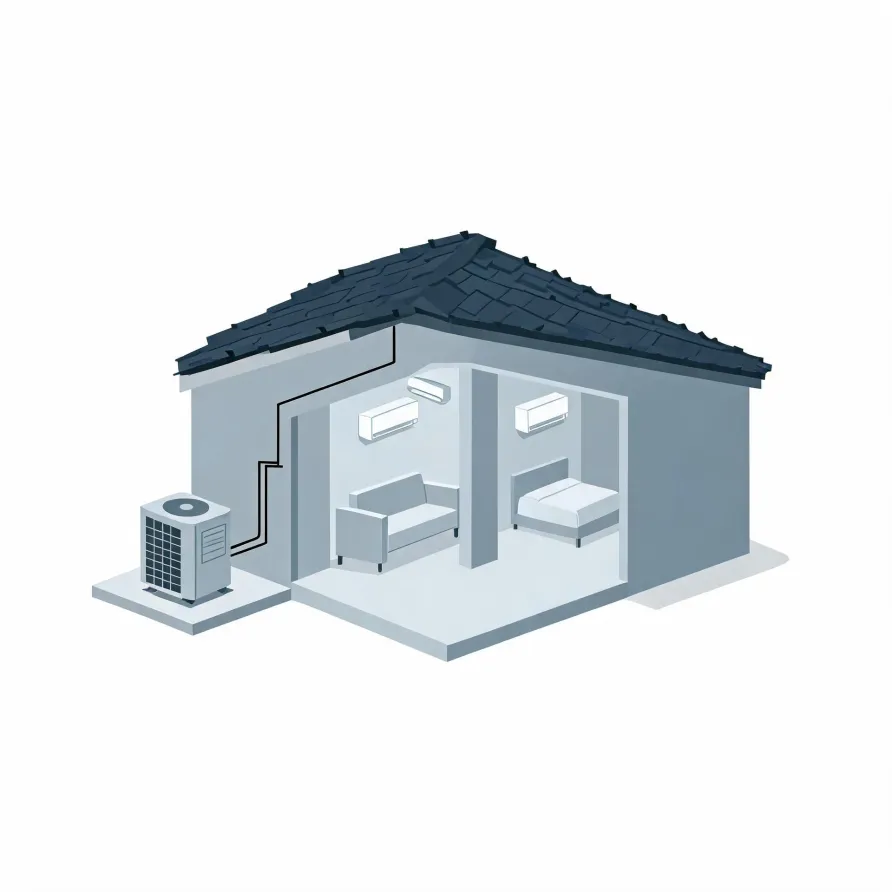
The indoor air handler mounts high on a wall inside the room being served, where it draws in room air and delivers conditioned air back out. The outdoor condenser unit sits on the ground or a bracket outside the house and holds the compressor and the main coil that does the heavy work.
A refrigerant line set runs through a small opening in the wall to connect the two units, traveling alongside a condensate drain line and the power and communication cables that let the indoor and outdoor units work together. A contractor secures all of these connections and sets the outdoor unit on a stable pad or mounting surface before the system can run.
The drawing shows the general layout of these components, and a licensed contractor determines exactly how each one applies to your house.
Find a contractor in Hancock CountyHancock County, Indiana, by the numbers
91 severe weather events were recorded in Hancock County, Indiana between 2015 and 2024.
NOAA National Centers for Environmental Information, Storm Events Database, bulk CSV export, events 2015-01-01 through 2024-12-31.Half the homes in Hancock County, Indiana were built in 1991 or earlier (2020-2024 ACS 5-year).
U.S. Census Bureau, 2020-2024 American Community Survey 5-Year EstimatesHancock County, Indiana holds 34,370 housing units (2020-2024 ACS 5-year).
U.S. Census Bureau, 2020-2024 American Community Survey 5-Year EstimatesOwners occupy 79.5% of the occupied homes in Hancock County, Indiana (2020-2024 ACS 5-year).
U.S. Census Bureau, 2020-2024 American Community Survey 5-Year EstimatesSevere Weather Events in Hancock County
Hancock County's climate puts real demands on heating and cooling equipment, and those demands are not abstract. A mini-split sized and installed for local conditions handles the load that local weather actually creates.
91 severe weather events, 2015–2024. Source: NOAA National Centers for Environmental Information, Storm Events Database.