
Tell us about the job
Takes about a minute. No obligation.
A contractor quoting a mini-split install in Warren County has to account for what the house actually demands of the system, and the local weather record is a modest part of that picture. 34 severe weather events were recorded in Warren County, Indiana between 2015 and 2024. At that rate, severe weather sits in the background rather than defining the operating conditions a new system will face. What shapes the install decision here is the building's layout, the existing ductwork or lack of it, and how well the previous equipment was sized and set. A contractor who gets those variables right is doing the work that keeps a system running.
The electrical panel already in the house is what decides how a mini-split installation goes in Warren County. Half the homes in Warren County, Indiana were built in 1973 or earlier (2020-2024 ACS 5-year). Panels in homes that age were sized for the loads of their era, and a new mini-split draws differently than what those circuits were laid out to carry. A contractor will assess what is already there before anything else gets quoted or scheduled.
The Parts of a Mini-Split System and What Gets Installed
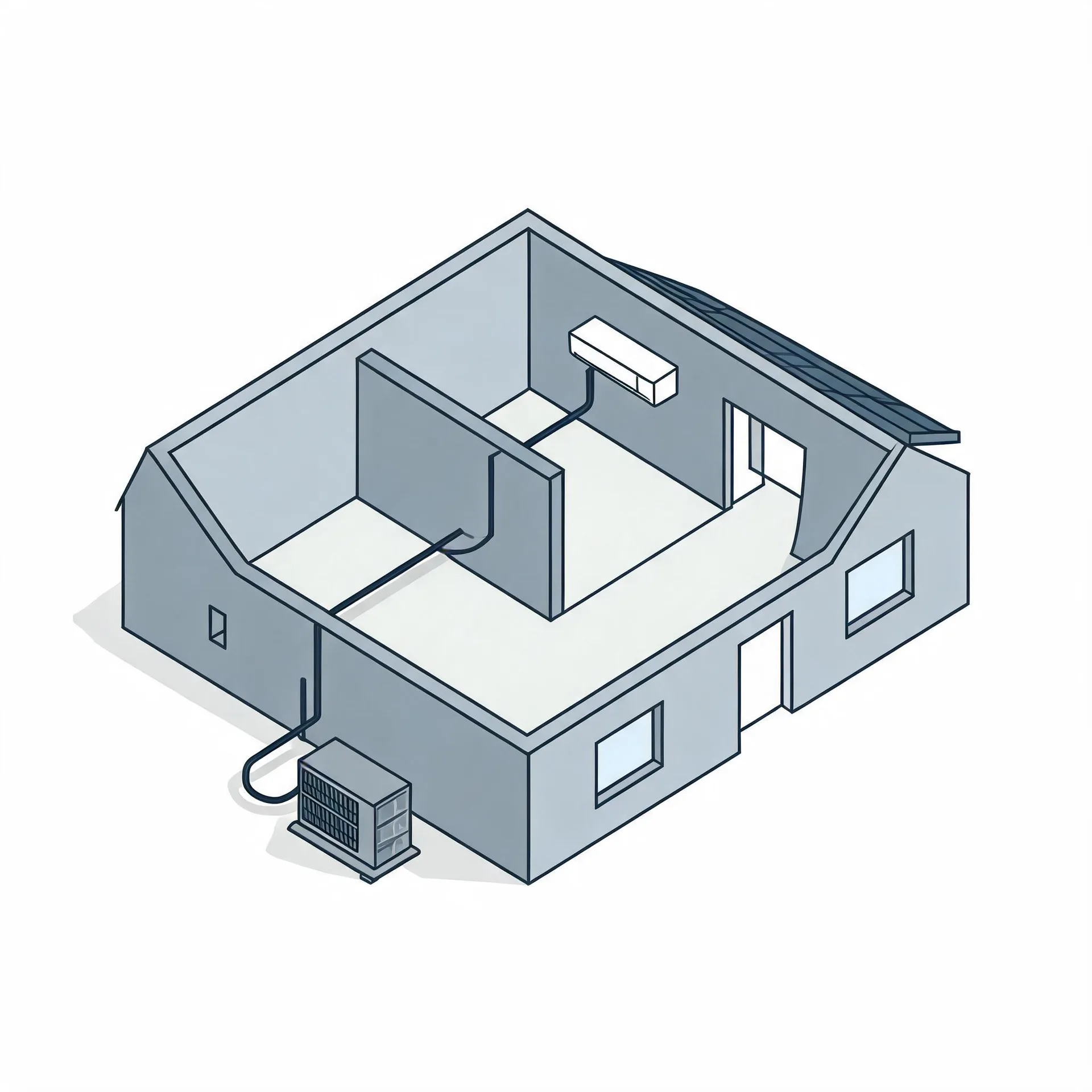
The indoor air handler mounts high on a wall inside the room and is the piece a homeowner sees every day. It draws room air across its coil and delivers conditioned air back into the space. Each zone in the house gets its own unit, sized and positioned by the contractor to cover that room.
The outdoor condenser sits on a pad or bracket outside the house and holds the compressor and the main coil. A pair of refrigerant lines and a power cable run through a small hole in the wall to connect the outdoor unit to each indoor handler. A condensate drain line also exits the indoor unit and routes moisture out of the building.
The drawing shows a typical layout, and a licensed contractor determines what the installation calls for in your specific home.
Find a contractor in Warren CountyWarren County by the Numbers
34 severe weather events were recorded in Warren County, Indiana between 2015 and 2024.
NOAA National Centers for Environmental Information, Storm Events Database, bulk CSV export, events 2015-01-01 through 2024-12-31.Half the homes in Warren County, Indiana were built in 1973 or earlier (2020-2024 ACS 5-year).
U.S. Census Bureau, 2020-2024 American Community Survey 5-Year EstimatesWarren County, Indiana holds 3,706 housing units (2020-2024 ACS 5-year).
U.S. Census Bureau, 2020-2024 American Community Survey 5-Year EstimatesOwners occupy 82.4% of the occupied homes in Warren County, Indiana (2020-2024 ACS 5-year).
U.S. Census Bureau, 2020-2024 American Community Survey 5-Year EstimatesSevere Weather Events in Warren County
The local climate shapes how hard heating and cooling equipment has to work, and how reliably it needs to hold up over time. A mini-split sized and installed for Warren County's conditions performs differently from one that is not.
34 severe weather events, 2015–2024. Source: NOAA National Centers for Environmental Information, Storm Events Database.