
Tell us about the job
Takes about a minute. No obligation.
Sizing a mini-split for Boone County is not a catalog exercise. 99 severe weather events were recorded in Boone County, Indiana between 2015 and 2024. At that rate, severe weather is a standing part of the operating environment, and a contractor quoting an install here has to account for what the unit will be running against season after season. Refrigerant line routing, mounting position, and unit capacity all get weighted against a climate that pushes equipment regularly. A system that is undersized or poorly positioned will feel that load faster.
The electrical panel is the first thing a contractor opens a conversation about on a mini-split job here. Half the homes in Boone County, Indiana were built in 1995 or earlier (2020-2024 ACS 5-year). A house wired in that era was built around different load assumptions, and a mini-split's power draw has to be matched against what the existing service actually delivers. If the panel is already at capacity, the equipment choice and the installation scope change. The ductwork question drops away entirely with a mini-split, which is part of the appeal, but the electrical question stays.
The Parts of a Mini-Split System and What Gets Installed
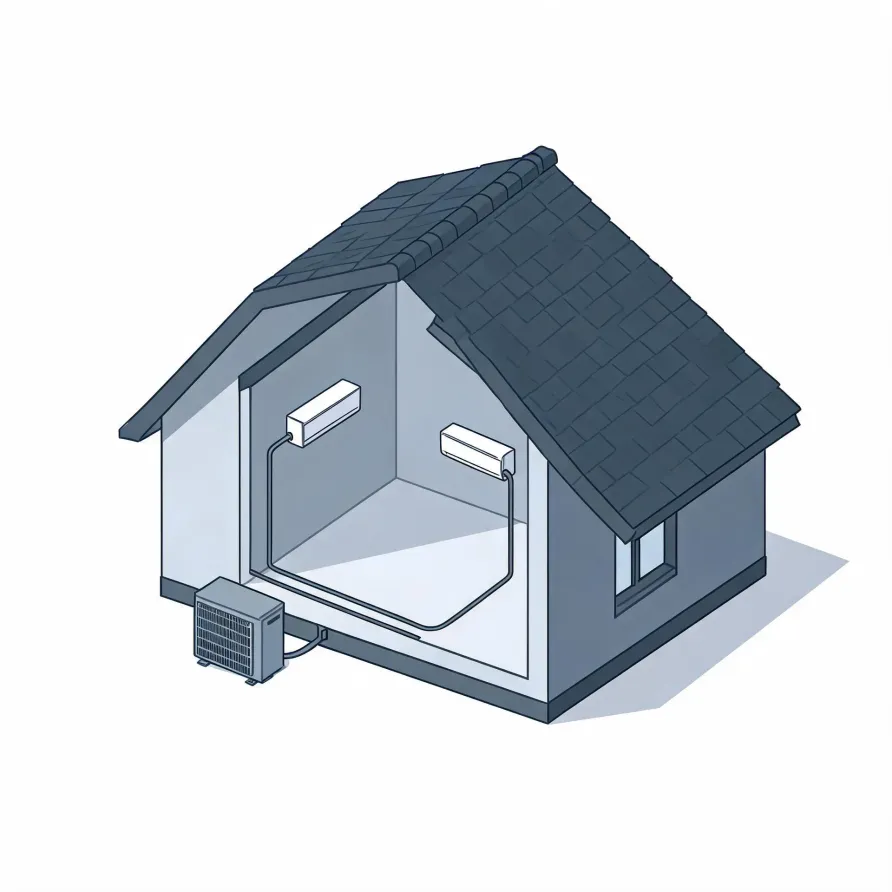
The indoor air handler mounts high on an interior wall inside the room being conditioned. It is the piece the homeowner sees every day, and it is where conditioned air enters the space. The outdoor condenser unit sits outside the home, typically on a pad or bracket, and houses the compressor.
A refrigerant line set runs through a small opening in the wall to connect the two units, carrying the refrigerant between them. A condensate drain line also runs from the indoor unit to the outside, clearing moisture that collects during operation.
The drawing shows a typical layout, and a licensed contractor determines exactly what the installation requires for your house.
Find a contractor in Boone CountyBoone County, Indiana, by the numbers
99 severe weather events were recorded in Boone County, Indiana between 2015 and 2024.
NOAA National Centers for Environmental Information, Storm Events Database, bulk CSV export, events 2015-01-01 through 2024-12-31.Half the homes in Boone County, Indiana were built in 1995 or earlier (2020-2024 ACS 5-year).
U.S. Census Bureau, 2020-2024 American Community Survey 5-Year EstimatesBoone County, Indiana holds 29,737 housing units (2020-2024 ACS 5-year).
U.S. Census Bureau, 2020-2024 American Community Survey 5-Year EstimatesOwners occupy 78.8% of the occupied homes in Boone County, Indiana (2020-2024 ACS 5-year).
U.S. Census Bureau, 2020-2024 American Community Survey 5-Year EstimatesSevere Weather in Boone County
How hard heating and cooling equipment works depends on what the local climate demands of it. Boone County's weather record shapes the load a mini-split carries, which makes it a factor worth knowing before installation.
99 severe weather events, 2015–2024. Source: NOAA National Centers for Environmental Information, Storm Events Database.