
Tell us about the job
Takes about a minute. No obligation.
A mini-split running through Marion County seasons does not get an easy ride. 227 severe weather events were recorded in Marion County, Indiana between 2015 and 2024. At that rate, severe weather is a standing condition here, not an occasional interruption, and every outdoor unit in the county has been working against it. When a contractor opens a system for repair, compressor wear, refrigerant stress, and coil condition all have to be read against what the equipment has already been asked to do. Age and installation quality still matter, but neither explains a failed component on its own without first accounting for the load this county puts on outdoor hardware.
Refrigerant lines run through walls that have been patched around, wiring gets spliced where someone needed more reach, and condensate drain paths end up rerouted in ways that never made it onto any diagram. Half the homes in Marion County, Indiana were built in 1973 or earlier (2020-2024 ACS 5-year). That history means a repair on a mini-split here is often a reconstruction exercise before it is a parts exercise. A contractor opening the indoor head or tracing the line set back to the outdoor unit finds conditions that reflect every hand that touched the system before theirs. Whether the refrigerant charge is recoverable, or the line set sound enough to reuse, gets settled by what is actually there.
The Parts of a Mini-split a Contractor Checks During Repair
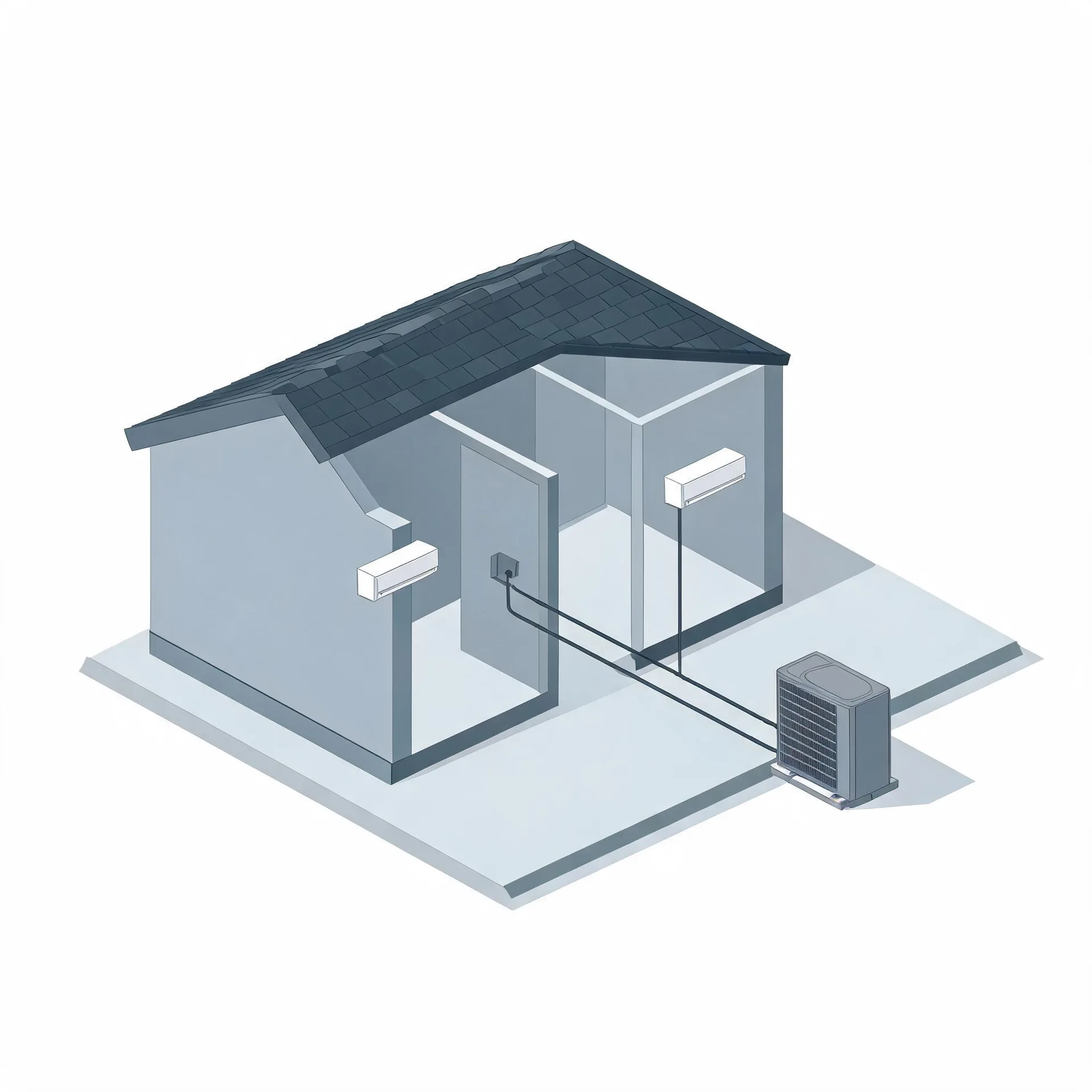
The indoor air handler is the piece most homeowners notice first. It mounts high on an interior wall and pushes conditioned air into the room. When it malfunctions, the room may get no airflow at all, or the unit runs but does nothing useful. The contractor will pull the panel and look at the fan wheel, the evaporator coil, and the sensors that tell the system what to do.
Outside, the condenser unit sits on a pad or bracket against an exterior wall and holds the compressor, the condenser coil, and the expansion valve. The refrigerant line set and the condensate drain run between the two units through a small opening in the wall. Faults in the compressor or a blocked drain line show up here, and so do refrigerant issues that starve the indoor coil of what it needs.
The drawing shows a typical layout, and a licensed contractor determines which components are involved in your particular situation.
Find a contractor in Marion CountyMarion County, Indiana, by the numbers
227 severe weather events were recorded in Marion County, Indiana between 2015 and 2024.
NOAA National Centers for Environmental Information, Storm Events Database, bulk CSV export, events 2015-01-01 through 2024-12-31.Half the homes in Marion County, Indiana were built in 1973 or earlier (2020-2024 ACS 5-year).
U.S. Census Bureau, 2020-2024 American Community Survey 5-Year EstimatesMarion County, Indiana holds 441,040 housing units (2020-2024 ACS 5-year).
U.S. Census Bureau, 2020-2024 American Community Survey 5-Year EstimatesOwners occupy 56.5% of the occupied homes in Marion County, Indiana (2020-2024 ACS 5-year).
U.S. Census Bureau, 2020-2024 American Community Survey 5-Year EstimatesSevere Weather Events in Marion County
Marion County's weather puts real stress on heating and cooling equipment, and that stress shows up as repair calls. A mini-split working harder through weather extremes is one that warrants closer attention from a local contractor who knows the load.
227 severe weather events, 2015–2024. Source: NOAA National Centers for Environmental Information, Storm Events Database.