Tell us about the job
Takes about a minute. No obligation.
A contractor diagnosing a failed mini-split in Parke County has to rule out the obvious culprits before anything else: how old the unit is, how it was installed, and whether it has been serviced. 33 severe weather events were recorded in Parke County, Indiana between 2015 and 2024. At that rate, severe weather is something a system here encounters now and then, not a steady grind that wears down components season after season. A refrigerant leak or a dead capacitor in this county points to the equipment itself, and a contractor prices the repair around what the unit actually needs.
Older housing tells a contractor relatively little about what generation of equipment is actually running inside it. Half the homes in Parke County, Indiana were built in 1972 or earlier (2020-2024 ACS 5-year). A mini-split installed into stock that old was added years, sometimes decades, after the house went up, which means the unit has its own age and its own wear history separate from the walls around it. When a repair call comes in, what matters is whether the refrigerant circuit, the control board, or the condensate drain has reached a point where replacement parts still exist for that model. If they do not, the repair conversation shifts into different territory entirely.
The Parts of a Mini-split a Contractor Checks When Something Goes Wrong
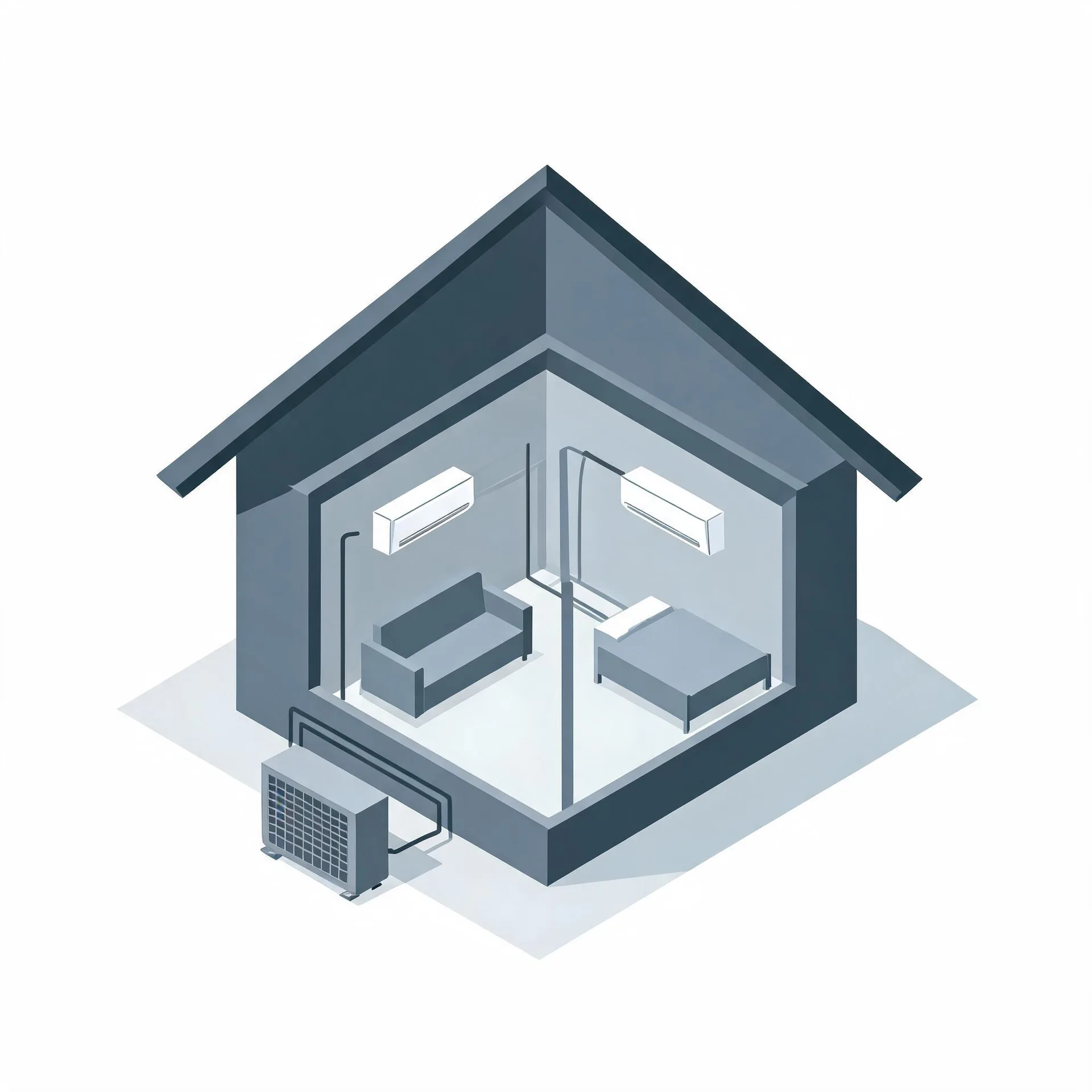
The indoor air handler mounts high on an interior wall and is the piece a homeowner notices first. It draws room air across a coil and a fan to move conditioned air into the space. When this unit is the problem, symptoms show up as weak airflow, ice on the coil, or air that never reaches the set temperature.
The outdoor condenser unit sits on a pad or bracket outside the house and holds the compressor, a second coil, and a fan. A refrigerant line set and a communication cable run through a small wall penetration to connect the two units. The contractor checks both ends and the line set itself, because faults in any of those three can produce the same symptoms inside.
The drawing shows a representative layout, and a licensed contractor determines what applies to this particular house and system.
Find a contractor in Parke CountyParke County by the numbers
33 severe weather events were recorded in Parke County, Indiana between 2015 and 2024.
NOAA National Centers for Environmental Information, Storm Events Database, bulk CSV export, events 2015-01-01 through 2024-12-31.Half the homes in Parke County, Indiana were built in 1972 or earlier (2020-2024 ACS 5-year).
U.S. Census Bureau, 2020-2024 American Community Survey 5-Year EstimatesParke County, Indiana holds 7,657 housing units (2020-2024 ACS 5-year).
U.S. Census Bureau, 2020-2024 American Community Survey 5-Year EstimatesOwners occupy 82.4% of the occupied homes in Parke County, Indiana (2020-2024 ACS 5-year).
U.S. Census Bureau, 2020-2024 American Community Survey 5-Year EstimatesSevere Weather Events in Parke County
Weather in Parke County puts real stress on heating and cooling equipment, and that stress shows up as repair calls. A mini-split running hard through whatever the sky delivers here is equipment that earns its maintenance.
33 severe weather events, 2015–2024. Source: NOAA National Centers for Environmental Information, Storm Events Database.