Tell us about the job
Takes about a minute. No obligation.

Sizing a mini-split in Miami County starts with what the house actually demands, not with a worst-case storm scenario. 60 severe weather events were recorded in Miami County, Indiana between 2015 and 2024. At that rate, severe weather is an occasional event here rather than a standing condition, which means the contractor's real work is matching capacity to the structure: wall assembly, window orientation, interior heat load, and how well the line set can be routed without long horizontal runs. A system undersized because a contractor skipped the site assessment will struggle every summer regardless of how many storms the county sees.
Ductwork is absent in a mini-split install, so the wall penetrations and line sets are straightforward. The electrical is a different question. Half the homes in Miami County, Indiana were built in 1961 or earlier (2020-2024 ACS 5-year). A panel put in to run the appliances of that era was sized for a different load profile than a modern mini-split condenser draws, and a contractor has to open the box and read what is actually there before quoting the electrical side of the job. Some panels have room; others need work before the install can proceed.
The Parts of a Mini-Split System and What Gets Installed
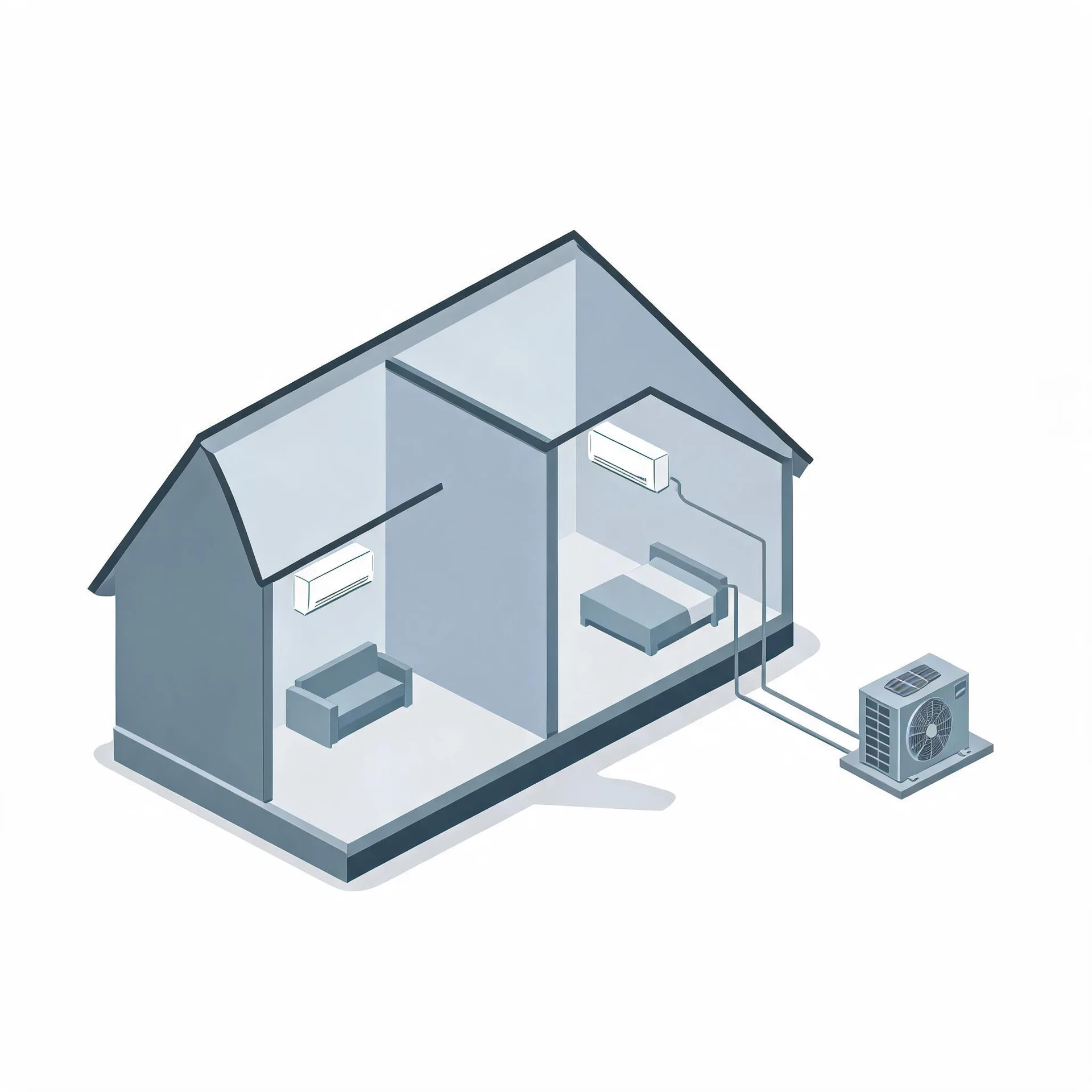
The indoor air handler mounts high on a wall inside the room being served, which is where most homeowners notice the system first. The outdoor condenser unit sits on a pad or bracket outside the house and contains the compressor and other core components. Together these two units form the working core of what a contractor installs.
A refrigerant line set runs through a small opening in the wall to connect the indoor and outdoor units, carrying the lines that let both sides function as one system. A condensate drain line also exits the indoor unit to route moisture outside. Some setups include a multi-zone configuration, where a single outdoor unit connects to several indoor handlers placed in different rooms.
The drawing shows a typical layout, and a licensed contractor determines what applies to your specific house and how each piece gets positioned within it.
Find a contractor in Miami CountyMiami County by the Numbers
60 severe weather events were recorded in Miami County, Indiana between 2015 and 2024.
NOAA National Centers for Environmental Information, Storm Events Database, bulk CSV export, events 2015-01-01 through 2024-12-31.Half the homes in Miami County, Indiana were built in 1961 or earlier (2020-2024 ACS 5-year).
U.S. Census Bureau, 2020-2024 American Community Survey 5-Year EstimatesMiami County, Indiana holds 14,952 housing units (2020-2024 ACS 5-year).
U.S. Census Bureau, 2020-2024 American Community Survey 5-Year EstimatesOwners occupy 76.2% of the occupied homes in Miami County, Indiana (2020-2024 ACS 5-year).
U.S. Census Bureau, 2020-2024 American Community Survey 5-Year EstimatesSevere Weather Events in Miami County
Heating and cooling equipment in Miami County works against local conditions, not abstract ones. What the weather puts on a system year after year is a real factor in what that system needs to handle, which is why installation decisions here are a local question.
60 severe weather events, 2015–2024. Source: NOAA National Centers for Environmental Information, Storm Events Database.