Tell us about the job
Takes about a minute. No obligation.
A contractor quoting a mini-split repair in LaGrange County starts with the basics: how old the unit is, whether it was installed correctly, and when it last received any attention. 62 severe weather events were recorded in LaGrange County, Indiana between 2015 and 2024. At that rate, severe weather is something a system here encounters now and then, not a chronic load that grinds components down season after season. A refrigerant leak, a failing capacitor, or a coil that stopped performing is far more likely traced back to years of deferred maintenance or a rushed original install than to what the sky has done. That is what shapes the diagnosis here.
Half the homes in LaGrange County, Indiana were built in 1982 or earlier (2020-2024 ACS 5-year). A mini-split that has been running in a house this old has usually been through at least one refrigerant standard, and when a contractor opens the system, what they find in the coil, the circuit board, and the condensate path reflects years of use that the exterior of the unit does not show. If the compressor or the control board needs replacing, the contractor checks whether the manufacturer still supplies that part for that model before the repair can be priced at all. A house built closer to yesterday does not raise that question at the same rate.
The Parts of a Mini-split a Contractor Checks During Repair
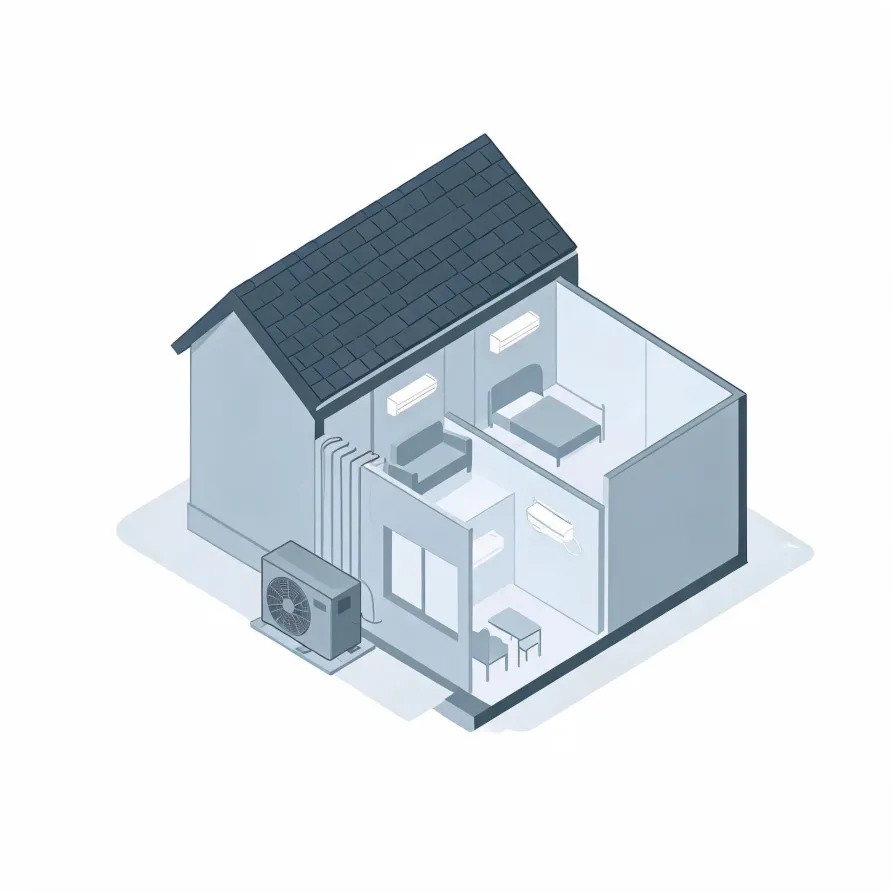
The indoor air handler mounts high on a wall inside the room and is the piece a homeowner notices first. It draws in room air, passes it across a coil, and pushes conditioned air back out. When this unit is the problem, the signs show up immediately: weak airflow, odd smells, or air that is not reaching the set temperature.
The outdoor condenser sits outside the house, usually on a pad or bracket at ground level or on a wall, and houses the compressor and the second coil. A refrigerant line set and a condensate drain line run between the two units, connecting the whole loop. The contractor works across all of these because a fault in one piece often shows its symptoms in another.
The drawing shows a typical layout, and a licensed contractor determines what applies to your specific system and home.
Find a contractor in LaGrange CountyLaGrange County, Indiana, by the numbers
62 severe weather events were recorded in LaGrange County, Indiana between 2015 and 2024.
NOAA National Centers for Environmental Information, Storm Events Database, bulk CSV export, events 2015-01-01 through 2024-12-31.Half the homes in LaGrange County, Indiana were built in 1982 or earlier (2020-2024 ACS 5-year).
U.S. Census Bureau, 2020-2024 American Community Survey 5-Year EstimatesLaGrange County, Indiana holds 15,151 housing units (2020-2024 ACS 5-year).
U.S. Census Bureau, 2020-2024 American Community Survey 5-Year EstimatesOwners occupy 83.0% of the occupied homes in LaGrange County, Indiana (2020-2024 ACS 5-year).
U.S. Census Bureau, 2020-2024 American Community Survey 5-Year EstimatesSevere Weather Events in LaGrange County
Extreme weather puts real stress on heating and cooling equipment, and the wear that stress causes shows up as repair calls. How often that happens in LaGrange County is a local fact, not a general one.
62 severe weather events, 2015–2024. Source: NOAA National Centers for Environmental Information, Storm Events Database.