Tell us about the job
Takes about a minute. No obligation.
A mini-split install in LaGrange County starts with what the site actually demands, and the local weather record is one part of that picture. 62 severe weather events were recorded in LaGrange County, Indiana between 2015 and 2024. At that rate, severe weather is a real but occasional presence, not the defining condition a system here runs against. A contractor setting refrigerant line lengths, siting the outdoor unit, and selecting capacity is solving for the building and its year-round load. The weather is a background variable, and installation quality is what a homeowner here will feel every season.
Ductwork is less relevant for a mini-split than for a central system, but the electrical picture in older stock matters a great deal. Half the homes in LaGrange County, Indiana were built in 1982 or earlier (2020-2024 ACS 5-year). A house built around that period was wired for the appliances and heating equipment of that era, and the service panel reflects those demands. When a contractor scopes a mini-split installation here, the panel comes first: whether it has room for a dedicated circuit, and whether the existing wiring will carry the new load without an upgrade. That answer shapes the quote.
The Parts of a Mini-Split System and What Gets Installed
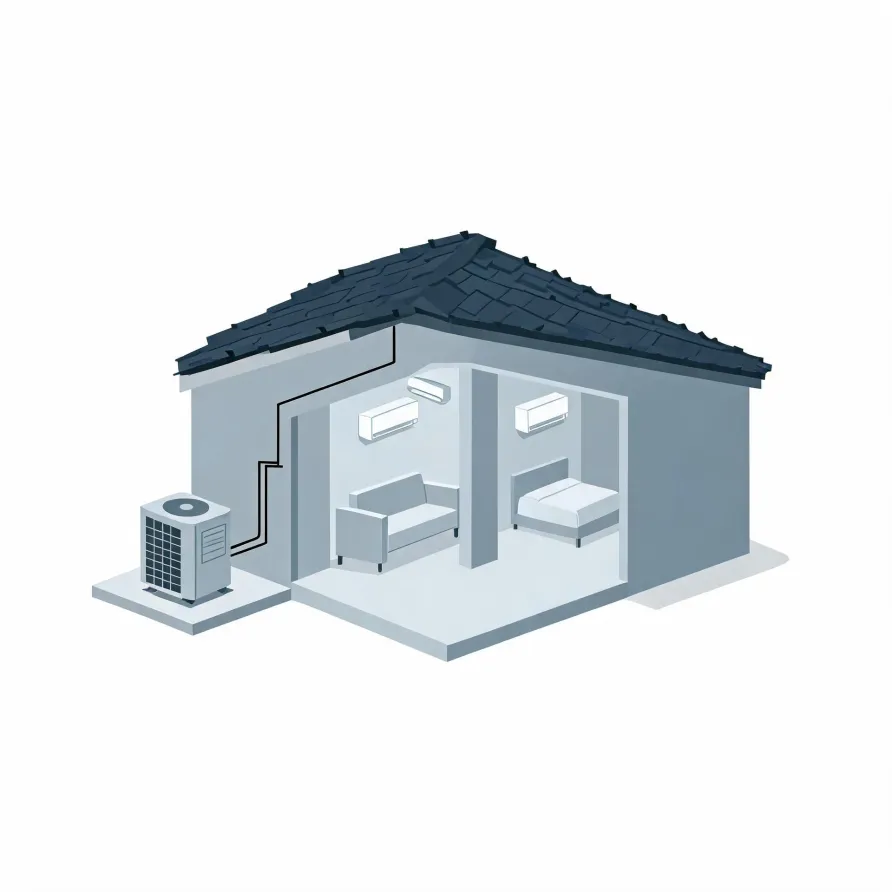
The indoor air handler mounts high on an interior wall in the room being conditioned. It is the piece a homeowner sees every day, and it is where conditioned air enters the living space. Outside the house, the outdoor condenser unit sits on a pad or bracket and houses the compressor and the heat exchange coils that do the heavy lifting.
A refrigerant line set runs through a small opening in the wall to connect the two units, carrying refrigerant between them. A condensate drain line also runs from the indoor unit to the outside, carrying away the moisture the air handler pulls from the air. A dedicated electrical disconnect is mounted near the outdoor unit as well.
The drawing beside this text shows the general layout of these components, and a licensed contractor determines exactly how they come together in your home.
Find a contractor in LaGrange CountyLaGrange County by the numbers
62 severe weather events were recorded in LaGrange County, Indiana between 2015 and 2024.
NOAA National Centers for Environmental Information, Storm Events Database, bulk CSV export, events 2015-01-01 through 2024-12-31.Half the homes in LaGrange County, Indiana were built in 1982 or earlier (2020-2024 ACS 5-year).
U.S. Census Bureau, 2020-2024 American Community Survey 5-Year EstimatesLaGrange County, Indiana holds 15,151 housing units (2020-2024 ACS 5-year).
U.S. Census Bureau, 2020-2024 American Community Survey 5-Year EstimatesOwners occupy 83.0% of the occupied homes in LaGrange County, Indiana (2020-2024 ACS 5-year).
U.S. Census Bureau, 2020-2024 American Community Survey 5-Year EstimatesSevere Weather Events in LaGrange County
Heating and cooling loads are shaped by what the local climate actually does, not just its averages. A mini-split sized and installed for conditions in LaGrange County handles the work that the weather here puts on it.
62 severe weather events, 2015–2024. Source: NOAA National Centers for Environmental Information, Storm Events Database.