Tell us about the job
Takes about a minute. No obligation.
A mini-split repair in this area asks a contractor to sort out what the system has actually been through before settling on a cause. 88 severe weather events were recorded in Delaware County, Indiana between 2015 and 2024. At that rate, severe weather is a standing condition in this county, not an occasional interruption, and its effects accumulate in the components that handle load: compressors, capacitors, and refrigerant lines all carry the record of what the system ran against. A contractor working a repair here checks those parts for stress and deterioration tied to weather load, not just age or installation error, because both are plausible explanations and the repair scope changes depending on which one is driving the failure.
Opened equipment in houses this old tells you what no service call can settle from the outside. Half the homes in Delaware County, Indiana were built in 1967 or earlier (2020-2024 ACS 5-year). A mini-split that has been running against that kind of accumulated thermal and seasonal stress may show a refrigerant circuit with micro-leaks at brazed joints, or control board corrosion a contractor has to trace component by component. Whether the parts the unit takes are still in production shapes the repair scope as much as the fault itself does.
The Parts of a Mini-Split a Contractor Checks During Repair
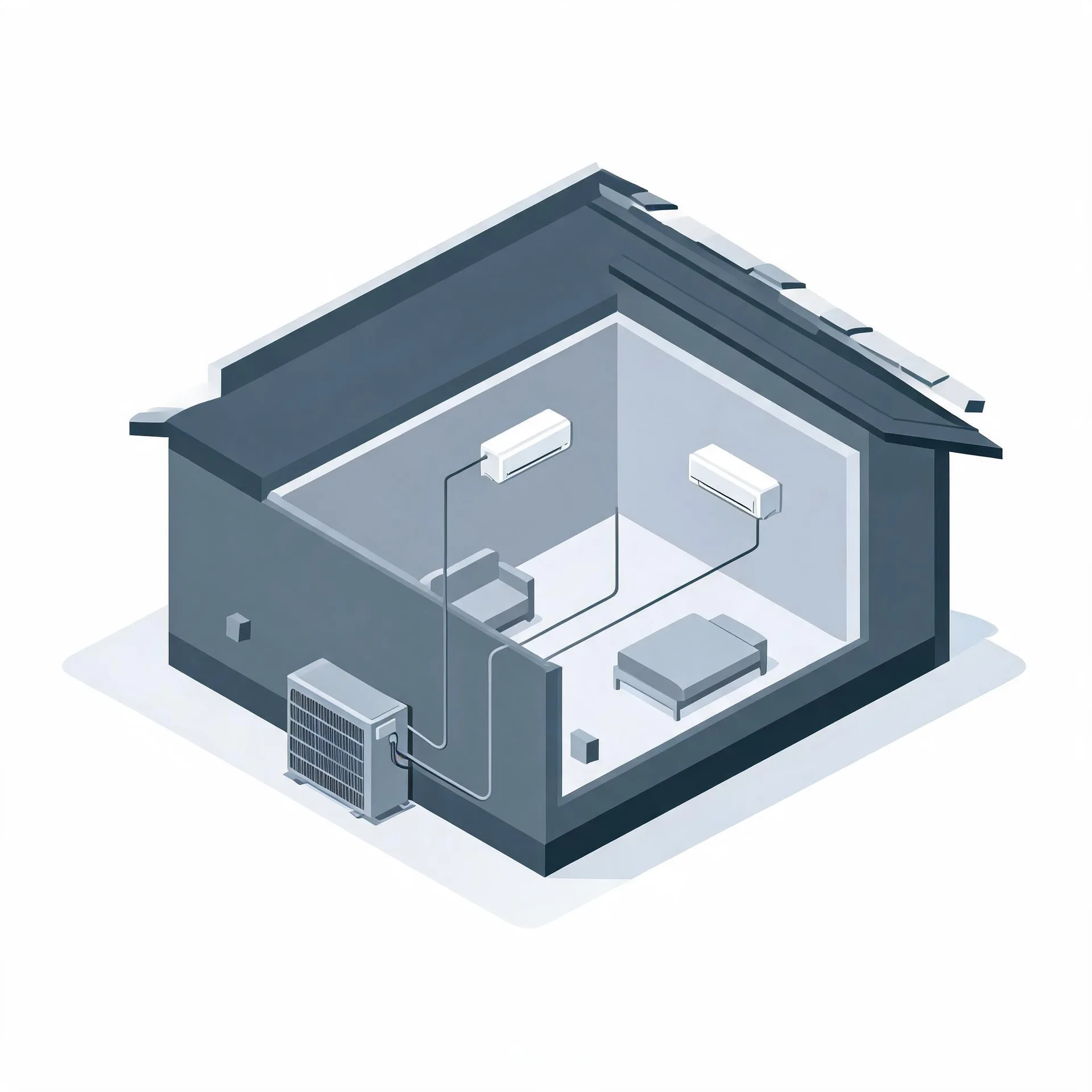
The indoor air handler is the piece most homeowners notice first, mounted high on an interior wall in the room being conditioned. It holds the evaporator coil, a fan, and the drain line that carries condensate away. When a room stops cooling or heating, or water appears on the wall below the unit, this is where a contractor looks first.
Outside the house sits the condenser unit, which holds the compressor and the outdoor coil. A refrigerant line set runs between the two units through a small penetration in the wall, and a control board inside each unit manages the signals that tell the system what to do. Electrical faults, refrigerant issues, and failed sensors often trace back to one of these points.
The drawing shows a general layout of how these pieces relate to one another, and a licensed contractor determines what applies to your specific setup.
Find a contractor in Delaware CountyDelaware County, Indiana, by the numbers
88 severe weather events were recorded in Delaware County, Indiana between 2015 and 2024.
NOAA National Centers for Environmental Information, Storm Events Database, bulk CSV export, events 2015-01-01 through 2024-12-31.Half the homes in Delaware County, Indiana were built in 1967 or earlier (2020-2024 ACS 5-year).
U.S. Census Bureau, 2020-2024 American Community Survey 5-Year EstimatesDelaware County, Indiana holds 51,635 housing units (2020-2024 ACS 5-year).
U.S. Census Bureau, 2020-2024 American Community Survey 5-Year EstimatesOwners occupy 66.5% of the occupied homes in Delaware County, Indiana (2020-2024 ACS 5-year).
U.S. Census Bureau, 2020-2024 American Community Survey 5-Year EstimatesSevere Weather Events in Delaware County
Weather puts direct load on heating and cooling equipment, and that load shapes what repairs come up and how often. What happens in Delaware County is the starting point for understanding what your mini-split is up against.
88 severe weather events, 2015–2024. Source: NOAA National Centers for Environmental Information, Storm Events Database.