
Tell us about the job
Takes about a minute. No obligation.
A contractor quoting a mini-split install in Elkhart County has to size the system for what this area actually puts it through, not for an average season somewhere else. 183 severe weather events were recorded in Elkhart County, Indiana between 2015 and 2024. At that rate, severe weather is a standing condition of operating here, and a unit sized too small for peak demand will run at its limits regularly rather than occasionally. That changes the install conversation: duct placement, outdoor unit siting, and capacity margins are local decisions shaped by this load, and a contractor who treats them as catalog defaults leaves the homeowner with a system working harder than it was designed to.
Electrical service is where a mini-split installation in Elkhart County tends to get complicated. Half the homes in Elkhart County, Indiana were built in 1977 or earlier (2020-2024 ACS 5-year). Houses built then were wired for the loads common to that period, and a mini-split's draw does not always fit what is already in the panel. Ductwork is less often the issue, since mini-splits bypass it. The panel is what a contractor prices around first.
The Parts of a Mini-split System and What Gets Installed
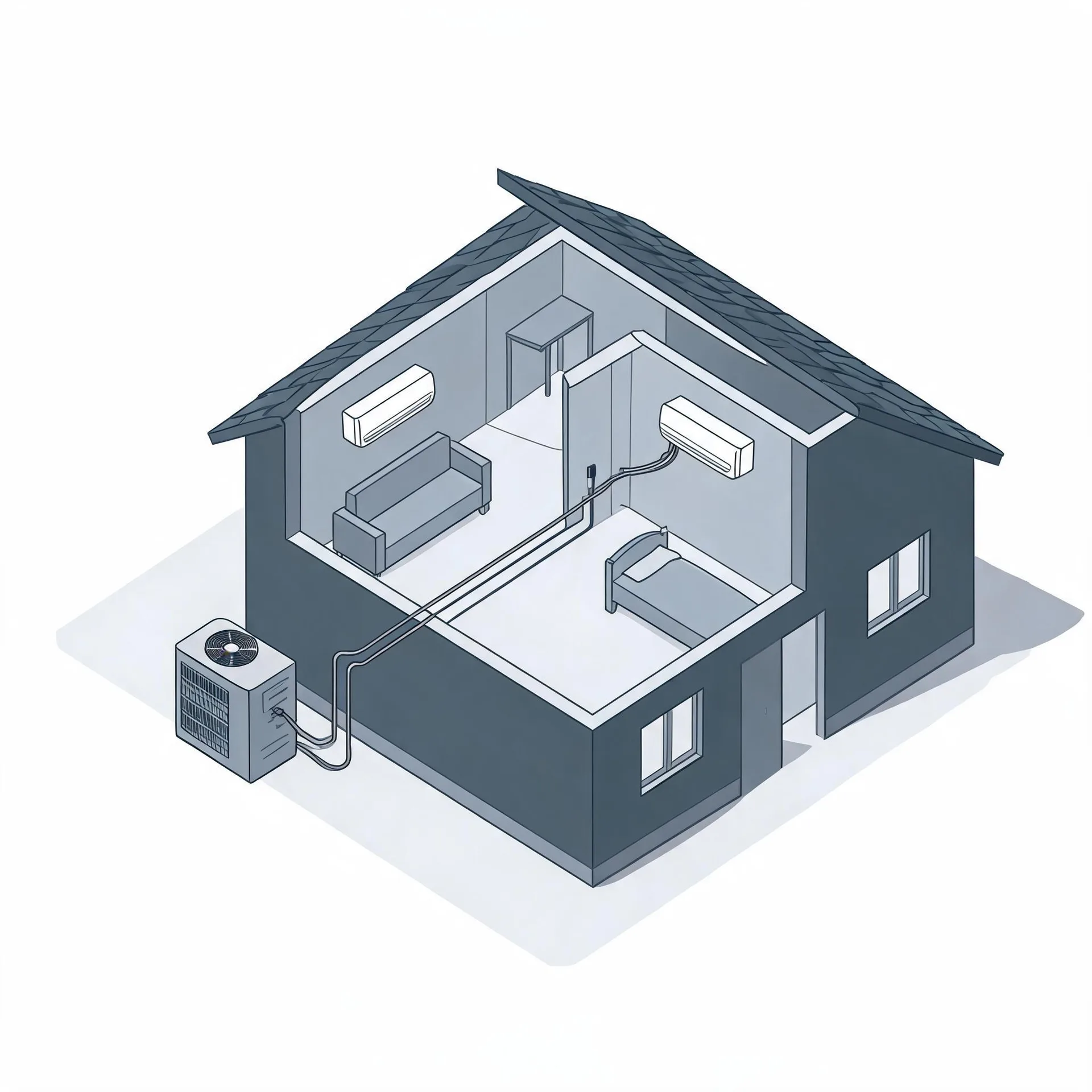
The indoor air handler mounts high on a wall inside the room being served, and that is where the conditioned air enters the living space. The outdoor condenser unit sits outside the house, typically on a pad or bracket against an exterior wall, and houses the compressor and coil that do the system's heavy lifting.
A refrigerant line set runs through a small penetration in the wall to connect the indoor and outdoor units, carrying refrigerant between them. A condensate drain line also runs from the indoor unit to carry away moisture, and a dedicated electrical circuit feeds the outdoor unit from the panel.
The drawing shows a general layout of these components, and a licensed contractor determines exactly how each one applies to your house.
Find a contractor in Elkhart CountyElkhart County, by the numbers
183 severe weather events were recorded in Elkhart County, Indiana between 2015 and 2024.
NOAA National Centers for Environmental Information, Storm Events Database, bulk CSV export, events 2015-01-01 through 2024-12-31.Half the homes in Elkhart County, Indiana were built in 1977 or earlier (2020-2024 ACS 5-year).
U.S. Census Bureau, 2020-2024 American Community Survey 5-Year EstimatesElkhart County, Indiana holds 80,493 housing units (2020-2024 ACS 5-year).
U.S. Census Bureau, 2020-2024 American Community Survey 5-Year EstimatesOwners occupy 71.6% of the occupied homes in Elkhart County, Indiana (2020-2024 ACS 5-year).
U.S. Census Bureau, 2020-2024 American Community Survey 5-Year EstimatesSevere Weather Events in Elkhart County
Weather extremes put a direct load on heating and cooling equipment, and that load shapes what a mini-split installation here needs to handle. Sizing and setup decisions are local decisions, and the weather record for this county is part of that picture.
183 severe weather events, 2015–2024. Source: NOAA National Centers for Environmental Information, Storm Events Database.